
November 21, 2026 7:00pm
-
What's Playing?
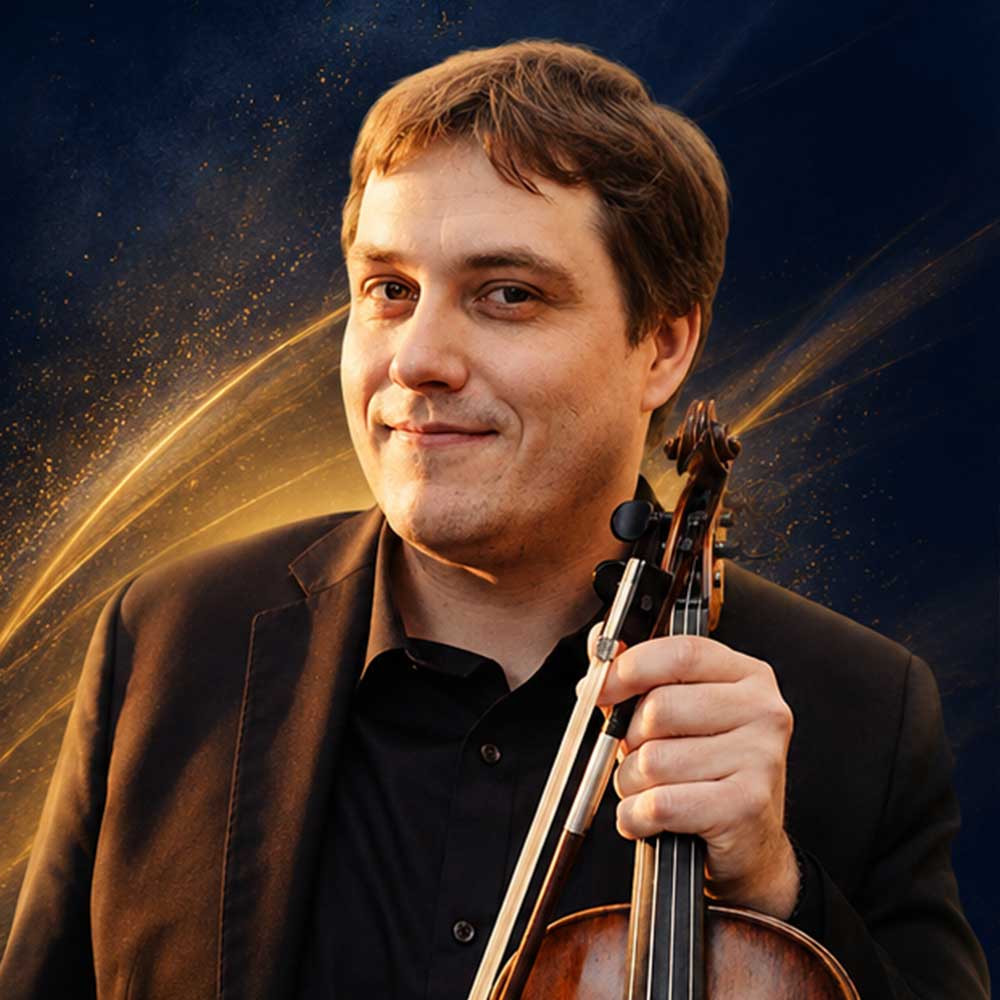
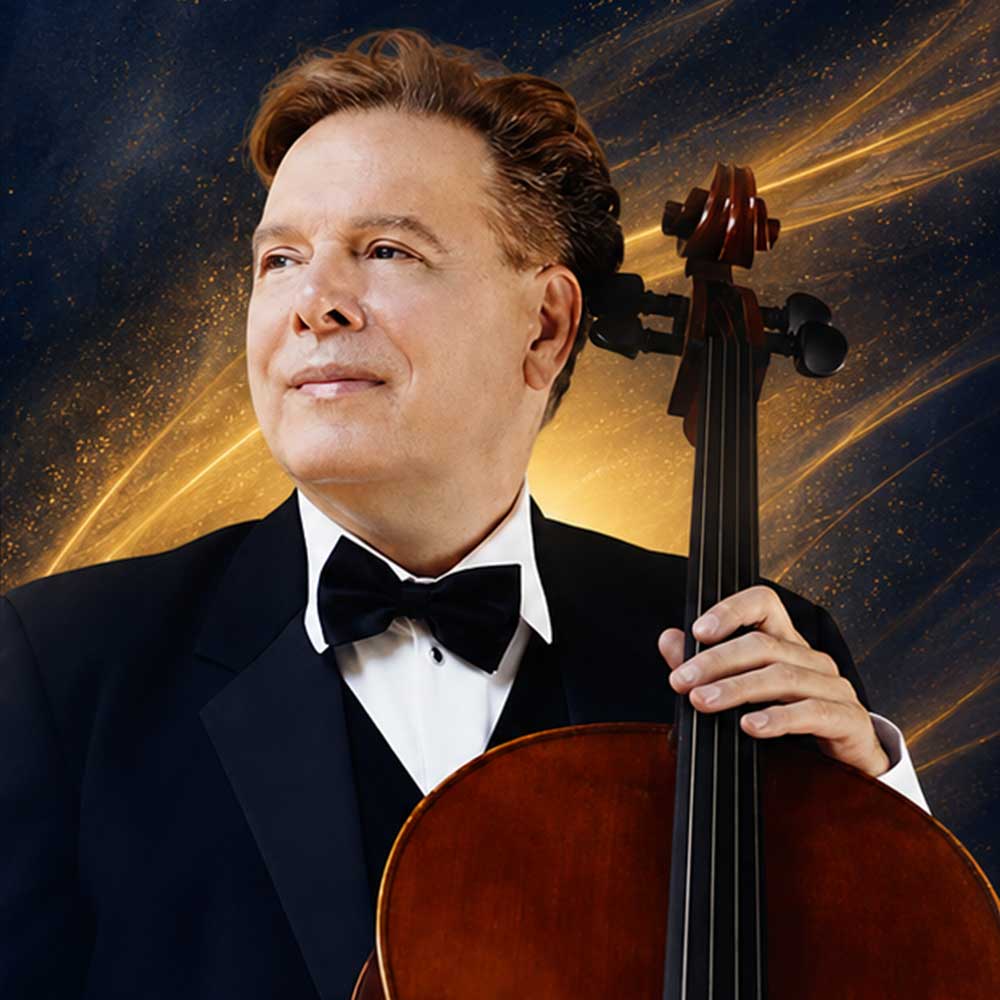
BRAHMS Double Concerto in A minor, Op. 102 (Evgeny Komarnitskiy, violin, David Calhoun, cello)
BEETHOVEN Symphony No. 7 in A, Op. 92
Program Information
"Relentless rhythm, raw energy, and one of the most electrifying finales ever written."
Inside the Music
There are some programs that are connected by a place, a period, or a particular musical style. This one is connected by something more fundamental: the way great composers create energy.
Both works on this program begin with relatively simple ideas and transform them into something far larger than their origins might suggest. Whether through conversation, development, or rhythmic momentum, Brahms and Beethoven demonstrate an extraordinary ability to take a single musical thought and allow it to grow into an entire musical world.
Johannes Brahms' Double Concerto in A minor occupies a unique place in his output. Completed in 1887, it was his final work for orchestra and, in many ways, a summation of everything he valued as a composer. Unlike many nineteenth-century concertos, which often place virtuosity at the forefront, Brahms was less interested in display than in dialogue. The work unfolds through an ongoing exchange of musical ideas, with themes passed, transformed, and developed through a process that feels almost conversational.
This emphasis on dialogue reflects one of Brahms' greatest strengths. He understood that music derives much of its power not from individual moments but from relationships—between melodies, between instruments, and between contrasting musical ideas. Throughout the concerto, themes rarely remain fixed. They evolve, respond to one another, and reveal new possibilities as the work progresses. The result is music of remarkable richness and depth, balancing lyric beauty with symphonic weight.
If Brahms builds his musical architecture through dialogue, Beethoven builds through motion.
Few symphonies possess a stronger sense of momentum than Symphony No. 7. Richard Wagner famously described it as "the apotheosis of the dance," a phrase that has followed the work for nearly two centuries. Yet the symphony's power extends beyond dance itself. What makes the Seventh so compelling is Beethoven's ability to generate enormous energy from the simplest rhythmic materials.
Throughout the work, short rhythmic figures are repeated, expanded, and transformed, creating an almost irresistible sense of forward movement. Even moments of repose seem charged with potential energy, as though the music is gathering strength for what comes next.
The celebrated Allegretto demonstrates this gift with particular clarity. Built upon a remarkably simple rhythmic foundation, the movement unfolds with extraordinary emotional depth and inevitability. Beethoven creates a sense of profound expression not through complexity but through repetition, accumulation, and subtle transformation. The result is music that feels both deeply personal and universally human.
The same principle drives the symphony's outer movements. Musical ideas are introduced, developed, and propelled forward with relentless determination. By the time the finale arrives, the accumulated energy of the entire symphony seems to burst forth at once. Few conclusions in orchestral music feel so exhilarating, and few composers have demonstrated such mastery of momentum.
Though separated by generations and differing greatly in temperament, Brahms and Beethoven share an important musical belief: that great music is not static. It grows. Ideas evolve. Themes develop. Energy accumulates. What begins as a simple gesture becomes something larger, richer, and more powerful than we could have anticipated at the outset.
That journey—from a single idea to an entire musical landscape—is at the heart of both works. It is also one of the reasons these masterpieces continue to speak so powerfully to audiences today.
TICKET INFORMATION
Tickets are $35 in advance for adults and are available through our website or by calling (855) 252-7276. Tickets can also be purchased in person at any Marine Bank & Trust location. To find a ticket outlet near you, click here. Tickets at the door are $40. All seating is general admission — seats are not assigned.
All SCSO concerts are free for those 18 and under or any college student with a valid student ID. Discounted tickets are available through the Symphony for Everyone program.
Season 18 All Access Pass and Flex Ticket holders: Your pass or flex tickets are valid for this concert and all Season 18 subscription concerts. All Access Pass holders will find their reserved seats waiting. Flex ticket holders do not need to call ahead — simply present your tickets at the door upon arrival.
Artist Information
Evgeny Komarnitskiy began his musical journey at the age of four, setting in motion a lifelong devotion to the art of violin playing. What began as a childhood fascination quickly evolved into a passionate pursuit of mastery, guided by exceptional teachers and a deep curiosity for musical expression.
A graduate with honors from the Vano Muradeli School of Music, Komarnitskiy studied under Irina Yerusalimskaya before continuing his training at the Sergei Prokofiev Music College under the guidance of Polina Podmazova. His education culminated at the renowned Gnesin Russian Academy of Music in Moscow, where he earned his degree under the mentorship of the esteemed Professor Leonid Bulatov. These formative years instilled in him both the technical brilliance and interpretive insight that have become hallmarks of his artistry.
Following his studies, Komarnitskiy joined the orchestra of the Kolobov Novaya Opera Theatre of Moscow—one of Russia’s premier operatic institutions—where he performed in more than seventy operas across the repertoire. His work there encompassed the great masters of the genre, including Wagner, Puccini, Tchaikovsky, Mussorgsky, and Korngold. The experience provided him with a profound understanding of the operatic tradition and cultivated an ability to navigate its drama, lyricism, and intensity with commanding artistry.
Since relocating to the United States, Komarnitskiy has swiftly established himself as a dynamic and respected performer. He has appeared as guest concertmaster with numerous ensembles, including the Space Coast Symphony Orchestra, the Villages Philharmonic Orchestra, the Brevard Symphony Orchestra, and the New York Gilbert & Sullivan Players. His performances are distinguished by a warm tone, technical assurance, and an expressive style that resonates with both audiences and colleagues alike.
In addition to his orchestral work, Komarnitskiy maintains an active career as a soloist and chamber musician, performing across the United States and abroad. Whether leading from the concertmaster’s chair or captivating listeners in recital, he continues to bring his artistry to audiences with passion, elegance, and a deep reverence for the universal language of music.
Cellist David Calhoun has attracted the notice of today's visionary musicians, including David Amram, who sums up his credentials thus: "David Calhoun is what American music needs now . . . [he has] extraordinary talents as a virtuoso soloist and ensemble expert." His far-ranging career has included solo performances live in-concert with Liza Minnelli at Carnegie Hall, in scenes with the Martha Clarke Dance Company as both soloist and dancer, and chamber music collaborations with great violinists such as Ani Kavafian, Sydney Harth and Eric Friedman, the pianist Menahem Pressler and the Shanghai String Quartet. On the international stage Mr.Calhoun was featured as soloist with orchestra and chamber musician at the Tchaikovsky Festival in Tchaikovsky’s childhood home of Izhevsk, Russia. In the year 2000 he was honored to accept the invitation to perform a private millennial concert of solo Bach for Cardinals and clergy of the Vatican in Rome. He also has given concerts in Korea, Hong Kong, Japan, Germany, France, Canada and Mexico. Mr. Calhoun has led a delegation of young artists to perform as soloists with the Israel Chamber Orchestra in Tel Aviv, Israel, in a concert to benefit foster homes. Mr. Calhoun was appointed principal cellist of the Space Coast Symphony in 2025 by Maestro Aaron Collins, and is principal cellist of the Brevard Symphony, the Villages Philharmonic, and The Florida Philharmonic. He has performed as principal cellist with the American Symphony at Avery Fisher Hall at Lincoln Center, the American Ballet Theater at the Metropolitan Opera House, the New York Choral Society at Carnegie Hall, the Brooklyn Philharmonic at BAM, the American Composers Orchestra at Zankel Hall, the New York City Opera on tour, Musica Sacra at St. John the Divine, SONYC, etc. Mr. Calhoun has toured with Orpheus and with the Metropolitan Opera in Japan, and collaborates annually in chamber music concerts with members of the Metropolitan Opera Orchestra at Classical Tahoe. Mr. Calhoun has performed chamber music regularly in New York’s most prestigious venues, including Bargemusic, Carnegie Weill, the Brooklyn Museum Chamber Series, the Look and Listen Festival, the Seacliff Chamber Players, at Symphony Space as soloist, and the Metropolitan Museum of Art, where for 15 years he was tenured in year-round residence with the Orion Piano quartet. He has been a member of the acclaimed Kinor Quartet in residence at the annual World Bank Mozart Festival in Washington, D.C. , and the Omni Ensemble.
David Calhoun has been an active performer in New York’s vibrant music scene which has included many television, movie, and radio performances. He has recorded for RCA and has performed frequently, including the Kodaly Duo and the Debussy Sonata, on live broadcasts for radio stations WQXR and WNYC in New York City. He can be heard as the cello soloist in Bill Moyers’ PBS series “The Power of Myth.” He was invited by Philip Glass to record the first solo recording of Philip’s cello concerto “Naqoyqatsi” at Looking Glass Studios. In the popular vein, he has played numerous Broadway shows in New York (Phantom of the Opera, Les Miserables, Kiss of the Spiderwoman, Showboat to name a few) and cast recordings, and toured as solo cellist for stars such as Liza Minnelli, Rod Stewart and Willie Nelson. He has appeared several times on the Letterman Show and shows such as “One Life to Live”. A participant at the Manchester Music Festival, the Mostly Mozart Festival, the Chautauqua Festival, the Bard Festival, Waterloo Festival, Garret Lakes Festival, Summertrios, Mr. Calhoun is currently a resident artist of Classical Tahoe. His solo performance on the 2021 Naxos cd of works of John Gottsch was hailed by Gramophone as “fine solo work, committed and colourful" and “Glorious performance of the Bach Suites” (Allegro Magazine 2017)