April 3, 2027 7:00pm
Eau Gallie High School PAC - 1400 Commodore Boulevard
What's Playing?
THOMAS Come Sunday
ELLINGTON Three Black Kings
MARSALIS Violin Concerto in D Major (Evgeny Komarnitskiy, violin)
Program Information
"Three bold voices. One unmistakable American sound."
Inside the Music
There are programs that present American music as a timeline. Others gather works around a single genre, region, or historical moment. American Masters takes a more revealing approach. It places three composers in conversation and asks a larger question: What happens when American musical traditions are treated not as separate categories, but as living, overlapping languages?
Omar Thomas, Duke Ellington, and Wynton Marsalis each understand that American music is built from inheritance and transformation. Their music carries the sounds of worship, jazz, blues, dance, history, storytelling, and classical form. But none of them treats tradition as something preserved behind glass. Each composer takes what has been handed down and makes it speak in the present tense.
Omar Thomas’s Come Sunday begins with the spiritual world of the Black church. Its title acknowledges Duke Ellington, but Thomas’s musical language is entirely his own. The work moves through the atmosphere of preparation, testimony, communal energy, and release. It understands worship not only as prayer, but as a physical and emotional experience—a gathering of people, a gradual intensification of sound, and the moment when private feeling becomes collective expression.
The music draws naturally from several traditions at once. Elements of Bach, blues, jazz, rhythm and blues, and gospel exist side by side, not as quotations placed on top of one another, but as parts of a single musical vocabulary. Thomas understands that these traditions have always been in conversation. The disciplined architecture of classical music can coexist with the flexibility of jazz. A repeated figure can feel both carefully composed and alive in the moment. A melody can sound like an individual voice while also carrying the weight of a congregation.
In Come Sunday, the orchestra does not simply accompany an idea. It becomes the space in which that idea unfolds. The music gathers, waits, testifies, and finally erupts. Its emotional power comes from the sense that something is being prepared beneath the surface—something that cannot remain contained forever.
Duke Ellington’s Three Black Kings approaches American identity through history and symbol. The three kings of the title are Balthazar, one of the biblical Magi; Solomon, the great king of the Old Testament; and Martin Luther King Jr., whose leadership reshaped the moral and political imagination of the United States.
By placing these three figures together, Ellington creates a powerful connection between sacred history, wisdom, kingship, and the modern struggle for justice. The work is not a conventional biography of Martin Luther King Jr. Instead, it is a musical act of elevation. Ellington places King within a larger human and spiritual history, suggesting that his significance cannot be separated from the centuries of belief, suffering, leadership, and hope that came before him.
The music moves through sharply contrasting worlds. The opening portrait is driven by percussion and filled with an atmosphere of movement and ceremony. The portrait of Solomon turns toward dance, swing, and the social energy of the jazz bandstand. The final movement, devoted to Martin Luther King Jr., begins with a more reflective and bittersweet character before gathering strength and opening into gospel-inflected hope.
That progression is central to Ellington’s vision. He does not separate the sacred from the popular, or the concert hall from the dance floor. For Ellington, the orchestra can become a procession, a sermon, a nightclub, a royal court, and a public square. Each musical world carries its own dignity.
This is one of the reasons Ellington’s music remains so difficult to categorize. His work does not ask whether jazz belongs in the concert hall. It simply enters the concert hall with its full personality intact.
Wynton Marsalis’s Violin Concerto in D Major continues that conversation from another direction. The concerto uses the large-scale architecture of the classical tradition, but its musical imagination is shaped by jazz, blues, New Orleans, fiddle music, and the expressive freedom of the solo performer.
The solo violin moves through four contrasting worlds: Rhapsody, Rondo Burlesque, Blues, and Hootenanny. Each movement reveals a different kind of musical personality. The violin can sound inward and searching, sharply comic, deeply lyrical, or exuberantly communal. Marsalis treats virtuosity not as empty display, but as a form of storytelling. The soloist is not simply conquering difficult music; the soloist is traveling through different American landscapes.
The concerto’s energy comes from the tension between written structure and improvisatory instinct. Rhythms can swing, hesitate, lean forward, or seem to pull against the orchestral pulse. Melodies may stretch beyond the expected line. The solo violin is asked to be both highly precise and intensely personal.
That combination is essential to Marsalis’s musical world. The concerto is fully composed, but it never feels emotionally predetermined. It leaves room for risk, personality, humor, and surprise. The orchestra does more than provide a backdrop for the soloist. It becomes a constantly changing community—sometimes answering, sometimes challenging, sometimes surrounding the violin with the full force of the ensemble.
Placed side by side, these three works reveal three distinct ways of hearing America.
Thomas looks toward worship and communal release. Ellington looks toward history and the symbolic power of human leadership. Marsalis looks toward the many musical identities that can exist within a single artist and a single nation.
But the deeper connection is not simply that all three composers draw from jazz, gospel, or Black American musical traditions. It is that all three reject the idea that serious music must be detached from lived experience. Their music can be intellectually sophisticated without becoming emotionally remote. It can be formally ambitious while remaining connected to the body—to the pulse, the voice, the dance, the shout, and the gathering of people in a shared space.
This is what makes American Masters more than a collection of works by important composers. It is a portrait of American music as a continuing conversation between memory and invention.
The music remembers where it came from. It remembers the church, the bandstand, the street, the dance hall, the civil-rights movement, the concert stage, and the communities that carried these sounds forward. But it does not remain in the past.
It transforms.
And somewhere inside that transformation is the sound of America itself: many voices, many histories, and many musical languages becoming one living, unfinished song.
TICKET INFORMATION
Tickets are $35 in advance for adults and are available through our website or by calling (855) 252-7276. Tickets can also be purchased in person at any Marine Bank & Trust location. To find a ticket outlet near you, click here. Tickets at the door are $40. All seating is general admission — seats are not assigned.
All SCSO concerts are free for those 18 and under or any college student with a valid student ID. Discounted tickets are available through the Symphony for Everyone program.
Season 18 All Access Pass and Flex Ticket holders: Your pass or flex tickets are valid for this concert and all Season 18 subscription concerts. All Access Pass holders will find their reserved seats waiting. Flex ticket holders do not need to call ahead — simply present your tickets at the door upon arrival.
Artist Information
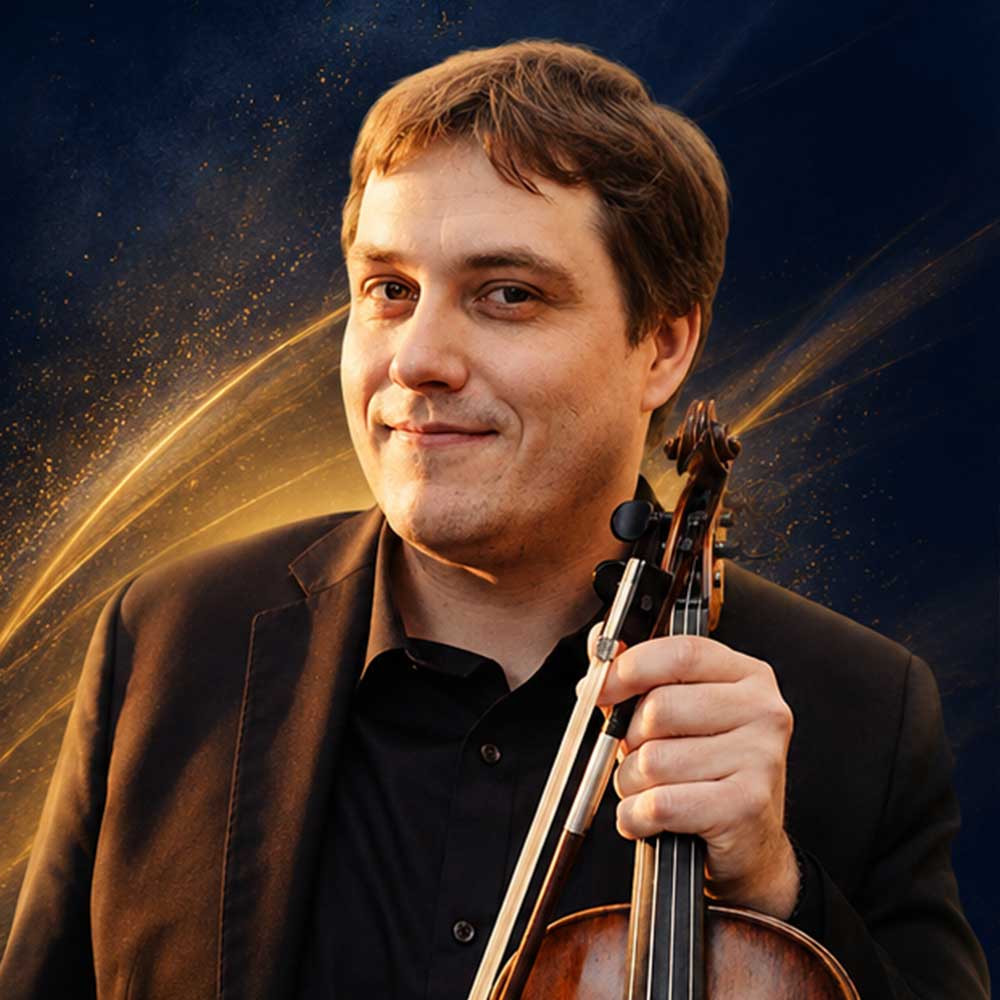
Evgeny Komarnitskiy began his musical journey at the age of four, setting in motion a lifelong devotion to the art of violin playing. What began as a childhood fascination quickly evolved into a passionate pursuit of mastery, guided by exceptional teachers and a deep curiosity for musical expression. A graduate with honors from the Vano Muradeli School of Music, Komarnitskiy studied under Irina Yerusalimskaya before continuing his training at the Sergei Prokofiev Music College under the guidance of Polina Podmazova. His education culminated at the renowned Gnesin Russian Academy of Music in Moscow, where he earned his degree under the mentorship of the esteemed Professor Leonid Bulatov. These formative years instilled in him both the technical brilliance and interpretive insight that have become hallmarks of his artistry. Following his studies, Komarnitskiy joined the orchestra of the Kolobov Novaya Opera Theatre of Moscow—one of Russia’s premier operatic institutions—where he performed in more than seventy operas across the repertoire. His work there encompassed the great masters of the genre, including Wagner, Puccini, Tchaikovsky, Mussorgsky, and Korngold. The experience provided him with a profound understanding of the operatic tradition and cultivated an ability to navigate its drama, lyricism, and intensity with commanding artistry. Since relocating to the United States, Komarnitskiy has swiftly established himself as a dynamic and respected performer. He has appeared as guest concertmaster with numerous ensembles, including the Space Coast Symphony Orchestra, the Villages Philharmonic Orchestra, the Brevard Symphony Orchestra, and the New York Gilbert & Sullivan Players. His performances are distinguished by a warm tone, technical assurance, and an expressive style that resonates with both audiences and colleagues alike. In addition to his orchestral work, Komarnitskiy maintains an active career as a soloist and chamber musician, performing across the United States and abroad. Whether leading from the concertmaster’s chair or captivating listeners in recital, he continues to bring his artistry to audiences with passion, elegance, and a deep reverence for the universal language of music.